Almost every device in the operating room claims to be interoperable. Almost none of them interoperate.
By Richard Carter, Chief Technology Officer at Proximie
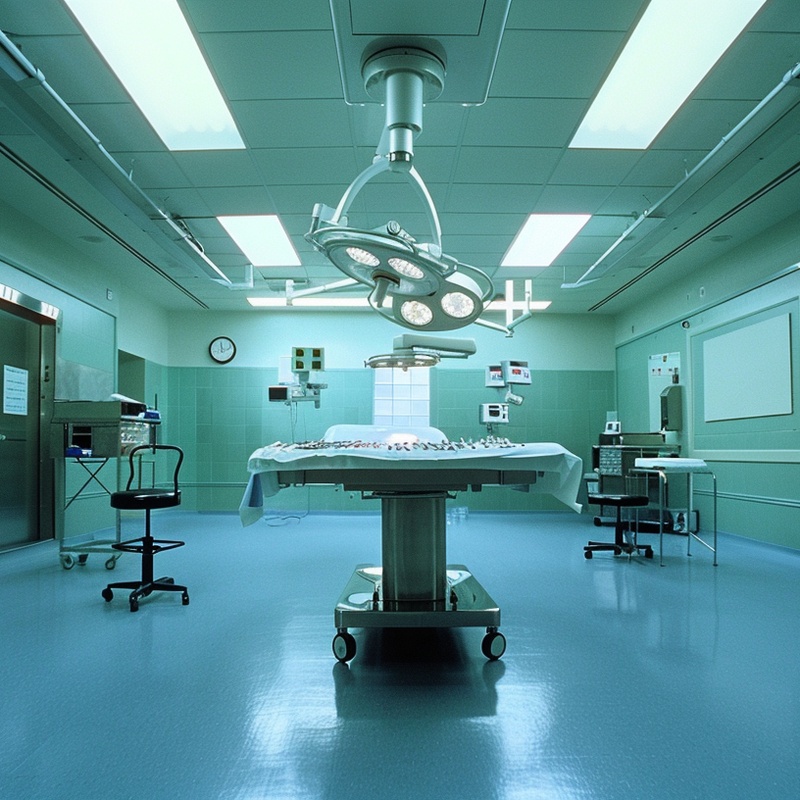
Step inside an operating room (OR) and you're surrounded by screens, video feeds, imaging, and vital signs, all updating in real time. Behind them, a constant stream of device and workflow data is being generated as well. Step outside, and almost all of it disappears.
Almost none of it goes anywhere else, which is strange given that nearly every device sold into that room claims to be interoperable.
The gap between claim and reality is a distinction lost in the sales pitch. Interoperability is the ability to connect, while interoperation is actually using that data to do something, and most ORs have plenty of the first and almost none of the second.
Why is the operating room so hard to connect?
This is not evidence of hospitals dragging their feet or surgeons resisting new tools.
Surgical devices, imaging systems, EHRs, robotics platforms, and monitoring equipment were built by different manufacturers at different times to solve different problems, which is an interoperability gap built into the engineering rather than any reluctance to change.
That gap is hardest to close inside the OR itself, because nowhere else in a hospital do so many people with so many competing priorities converge on the same few square meters under so much pressure, from the surgeon and scrub nurse to the anesthetist, OR manager, and IT lead.
Any technology that adds friction there gets routed around, and that workaround is a sign of good judgment under pressure, not stubbornness.
Plenty of American surgical units still run on a whiteboard and a nurse on the phone chasing the next patient down. The tools built to fix this have quadrupled in recent years, yet most only see half the room, since systems tracking the procedure cannot see the operational choreography around it, and systems tracking the choreography have no visibility into the clinical procedure itself.
What does the OR visibility gap cost health systems?
The cost of this blindness is not abstract. American hospitals cancel 7.2 million surgeries a year, costing the health system an estimated $32.7 billion, and only a small share of that is attributable to a genuine shortage of capacity. It is a visibility problem wearing capacity's clothes.
When one major US health system connected surgical data across sixty ORs with Proximie, modeling suggested roughly 9,000 additional procedures a year sitting inside capacity it already owned, worth close to $90 million - capacity that had existed all along but had never been identified.
Some of the plumbing needed to fix this is already being laid down.
HL7 and FHIR move health records between systems well, but neither was built for the operational data that runs an OR, let alone device telemetry. IHE ICE - “Integrating the Healthcare Enterprise - Interoperability in Clinical Environments” - is one of several newer standards starting to close that gap, letting an anesthesia machine, ventilator, and a surgical robot coordinate safely mid-procedure.
Useful as that is, it solves the easier half of the problem.
The data those devices generate still stays locked inside them, legible only to the machine that produced it, and what is missing is a scalable route into one structured record spanning the whole perioperative journey. ICE gets devices talking to each other. But until recently, nobody had solved the layer above it, the surgical intelligence layer that turns that conversation into something a hospital can learn from.
The deeper issue is not the standards themselves but whether hospitals can actually put what they capture to use.
What happens when OR data conflicts?
There’s something even worse than missing data: data that conflicts.
The OR isn’t short on data - it’s one of the richest data environments in a hospital. But different systems don’t always agree on what happened, and without context - where in the workflow and how each was captured - there’s no way of knowing which one to trust.
When a system substitutes one number for another, treating an EHR timestamp as a proxy for what actually happened in the room, it has stopped measuring and started guessing - and guesses compound badly at scale.
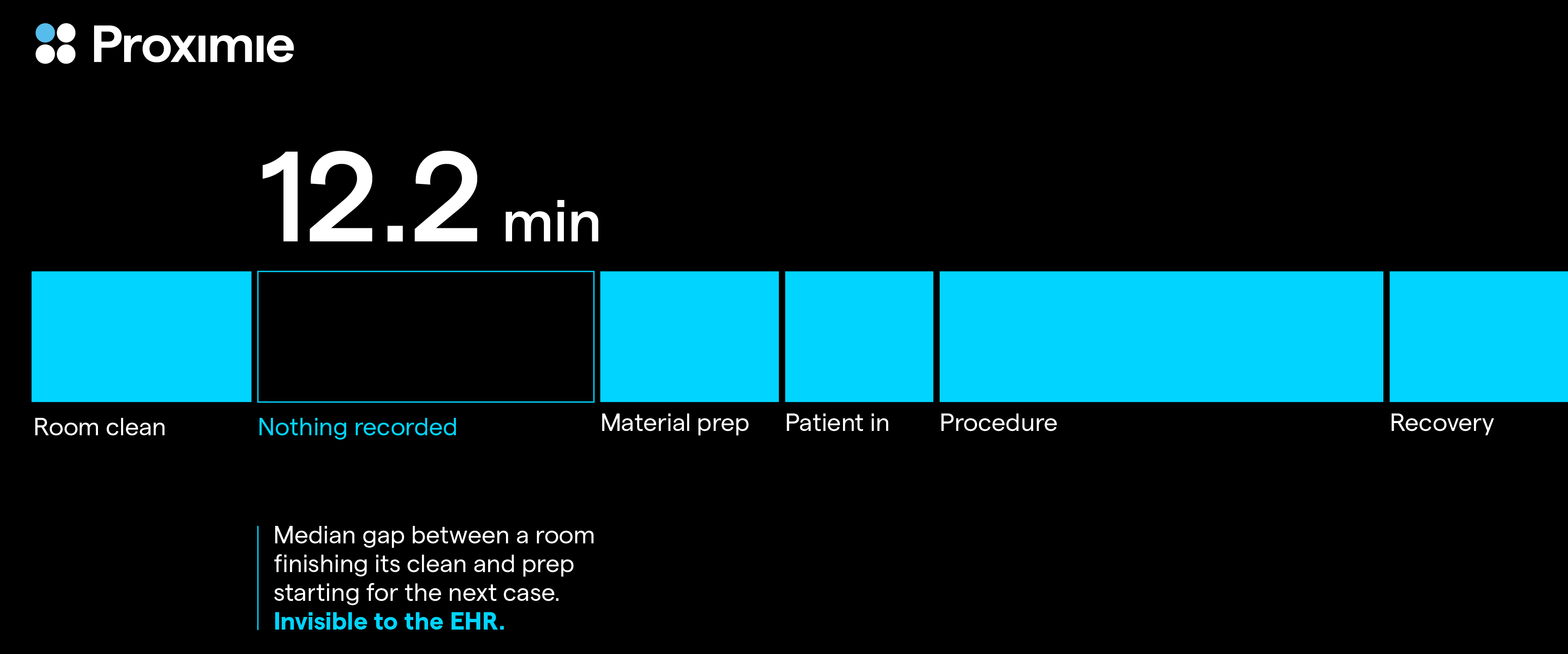
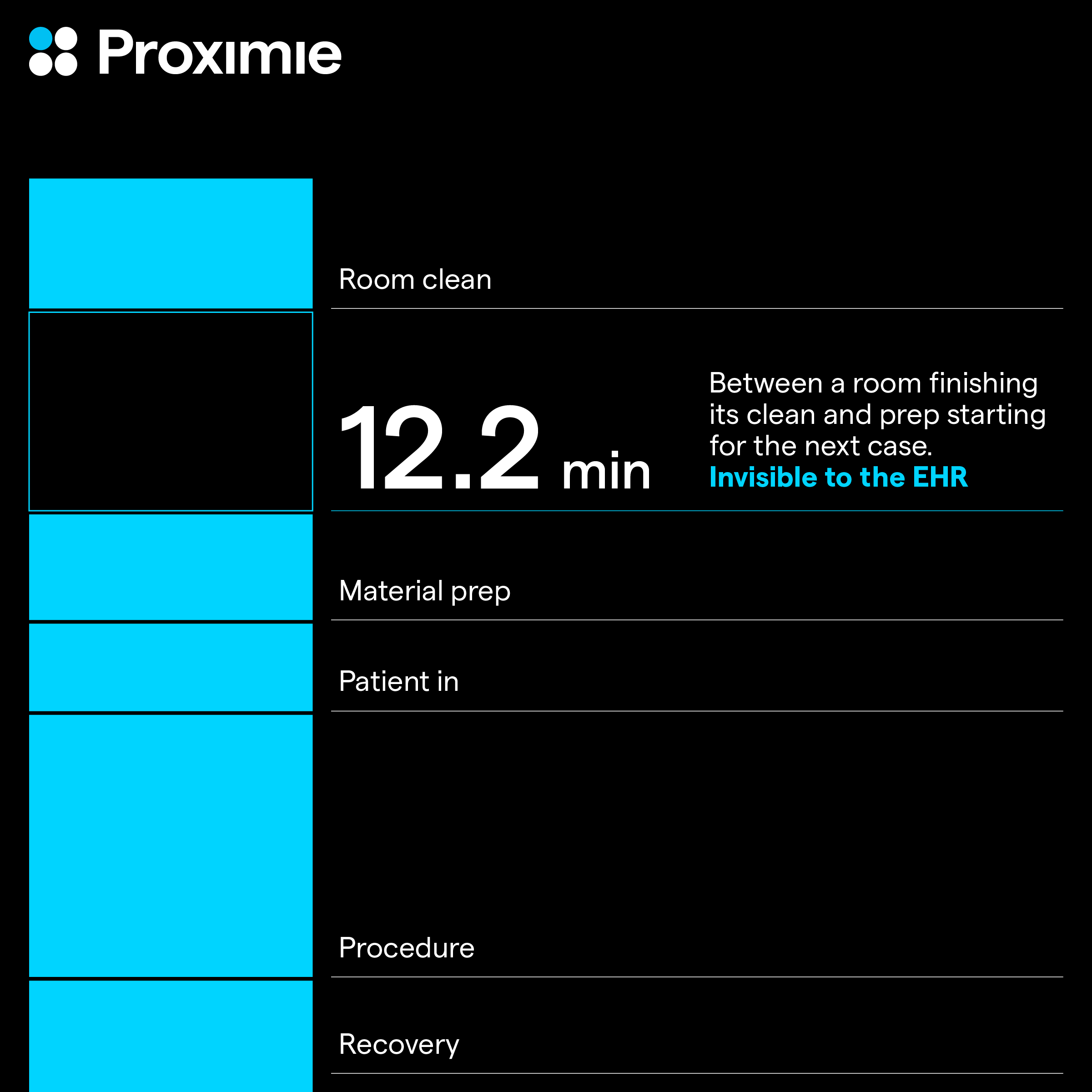
In one hospital, Proximie’s ambient computer vision picked up a 12.2 minute-median gap between a room finishing its clean and staff beginning material prep for the next case, the single largest reclaimable stretch of time in the dataset, invisible to the EHR because nothing in it was built to capture that gap. The same work found that roughly 59% of the EHR data beneath it contained errors.
Why is this the OR's Meaningful Use moment?
What makes this moment different is that the pieces finally exist to close both gaps at once. There is a real argument that the OR is approaching its own version of Meaningful Use, the 2009 policy that tied EHR adoption to federal incentives and helped build Epic into a company that now holds roughly 44% of the US acute care EHR market.
The OR was largely left out of that transformation.
That is beginning to change. CMS interoperability requirements are tightening and TEFCA is building a national framework for exchanging health data, the same kind of regulatory pressure that pushed EHR adoption over the line fifteen years ago.
The technology has caught up too. Multimodal models that hold vision, language, and clinical context together now run reliably at clinical scale, and edge hardware can process what a camera sees in real time, so ambient capture can finally take documentation off a surgical team's hands. None of this requires ripping out what already works, only connecting the imaging systems, EHRs, robotics platforms, and anesthetic monitors already in the room so they feed one picture and draw on it in return.
Done well, the payoff shows up in small ways that add up. A hospital can tell whether materials are ready before they are needed, whether the next patient is prepped when a room clears, and whether recovery happens promptly instead of drifting.
A few minutes saved at each handoff sounds trivial until multiplied across thousands of procedures a year, at which point it becomes the difference between a team finishing on time and one staying late for reasons nobody can quite explain.
Every case that passes through an intelligent OR adds to what the system already knows, and the advantage compounds quietly, case after case.
Why does surgical intelligence depend on interoperation?
That compounding is also why interoperation matters so much to the future of surgical AI.
As AI advances towards direct support of clinical decisions, an AI with only partial information on what’s going on in the OR during both its training and its deployment is not just inefficient, it is potentially dangerous.
AI needs a complete account of a patient's perioperative journey, clinical events and operational context held together as one picture, and interoperation is the only thing that can deliver that.
Once it does, AI stops producing reports about what already happened and starts acting on what is happening now. Updating a schedule the moment a case overruns, flagging the next patient before a room finishes turning over, letting a robot know which step of the procedure the team has reached.
None of that is possible while data sits partial or trapped inside the device that produced it, and all of it becomes possible once people, machines, and software act on the same information in real time.
What should hospital leaders ask of new OR technology?
So the question worth putting to any hospital leader evaluating new OR technology is simple. Does it connect to the ecosystem already built around it, or does it sit beside that ecosystem, adding one more silo to the pile?
The answer decides whether the intelligence in that OR compounds with every case or stays exactly where it started.
Get it right, and the result is not just a more efficient hospital, it is a surgeon walking into a room that already understands what the day requires, a team that gets to go home on time, and a patient treated sooner because capacity that was always there has finally become visible.
The OR still generates more data than almost anywhere else in a hospital. What has changed is that the data now has somewhere to go, and something to do.