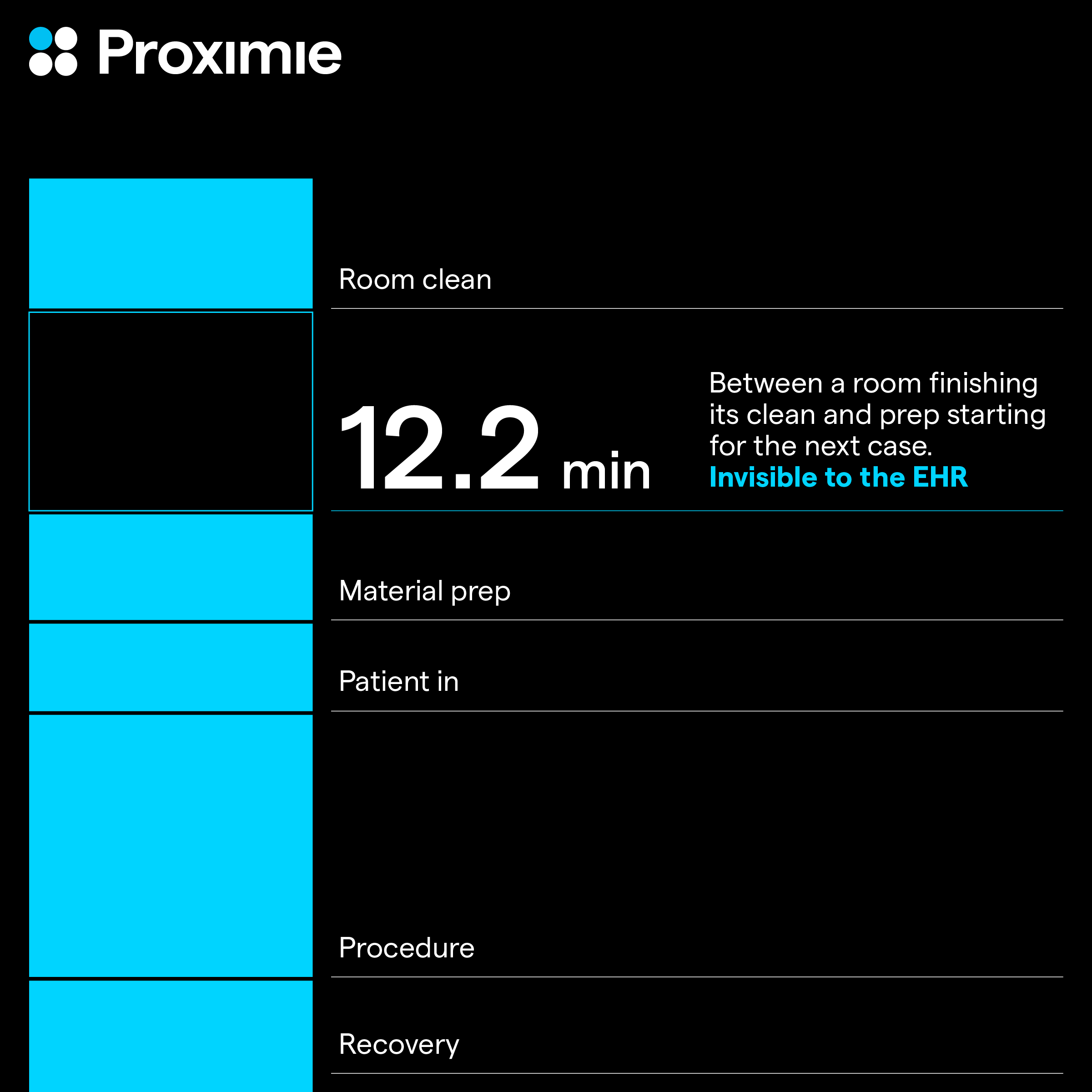

When the Proximie Intelligence Suite and its AI-enabled computer vision replaced manual timestamps at AdventHealth Celebration, the data told a story no manually-written report ever could. From improving surgical start times from 61% to 78% to increasing case capacity and expedited patient care, here's what happened next and what's coming at AORN Expo 2026.
Proximie (AWS Partner) delivers this capability on Amazon Web Services (AWS), supporting AdventHealth Celebration (AWS Customer).
The operating room (OR) was ready. The surgical team was ready. The instruments were laid out, the lights were on. The only thing missing was the patient.
It sounds unusual but at many hospitals this is a common occurrence and at AdventHealth Celebration, a busy hospital in Florida, this scenario was happening repeatedly and no one could see why.
OR efficiency has always been one of the hardest problems in surgery to quantify and track. On-time starts, turnover times, case capacity are metrics that matter enormously, both for hospital finances and patient safety, yet traditionally, the timestamps that underpin these metrics have been recorded manually, in the middle of busy schedules and everything else a surgical team has to manage.
The result is data that's variable and incomplete, and often too fragmented or reported too late to be useful.
A quality improvement audit at AdventHealth Celebration had flagged a dip in on-time starts, from 66.5% down to 61.87%. The clinical team knew something was wrong, but had struggled to locate exactly where.
Building trust before building data
Before Proximie was integrated in his team’s ORs, Senior Nurse Manager, Nicholas DeStefano, BSN, RN, CNOR had to ensure they were all comfortable with what was being proposed and the objectives of adopting AI.
Introducing data capture devices into the high-pressure environment of the OR was never going to be straightforward. DeStefano recently told the Association of Perioperative Registered Nurses that he ran open forums, brought in physician champions, and made one thing explicit from the start; that any footage or data captured from the OR would not be used to punish mistakes. Its purpose was to improve the system, not scrutinise individuals.
This foundation of trust and communication mattered. What followed worked because his teams could engage with the data and the findings in a completely honest and open way.
Writing recently on Linkedin, DeStefano says: "By shifting from manual assumptions to real visibility, we were able to support safer, more consistent orthopedic workflows — while reinforcing that technology should support teams, not surveil them."
What OR Intelligence revealed
With Proximie's OR Intelligence platform in place, and ambient data capture live from June 2024, every surgical case was automatically broken into four timestamped segments: Patient In to First Incision, Incision to Closure, Surgery Complete to Patient Out, and Wheels Out to Wheels In.
The platform uses AWS-native AI services, including Amazon SageMaker for computer-vision and AWS Bedrock for analytics, to generate real-time workflow insights.
For the first time, the team had an objective, continuous picture of where time was going. What they found was both surprising and, in hindsight, entirely logical. For every minute a first case started late, three more minutes compounded into the afternoon. Heatmaps showed staff routinely waiting in fully prepared rooms while patients had yet to arrive. Turnover times got worse as the day progressed, with the pattern peaking at around lunch. Regression analysis from the study indicated that more than 70% of turnover variation could be explained by the hour of the day.
The interventions that followed
Armed with real-time data, the multidisciplinary team made two targeted changes with these findings.
First, a Patient Care Coordinator role was created to run a "T-Minus" readiness protocol, which helped to standardise the touchpoints at 24 hours, 90 minutes, and closer in to help ensure the patient, surgeon, and OR were synchronised well ahead of wheels-in time.
Second, the team moved from sequential to parallel processing. While the circulator counted the back table, the anaesthesia team handled intubation simultaneously. Between cases, surgeons visited families and dictated notes at wheels-out, while pre-op teams began intravenous (IV) on the next patient and coordinators checked the next case cart before the room was even clean.
The process resembled something more like a Formula One pit crew than a surgical production line.
The data also prevented blanket conclusions. Some rooms saw different patterns: OR 1 was handling direct ICU transfers; the GYN service had shifted to more complex cases. This context, previously hidden by averages, was now visible.
The results
On-time starts rose from 64% to 71% year-over-year. In May 2025, the facility hit 78.45%, a six-year record.
Average turnover time fell by two minutes. Across a full surgical schedule these minutes build up into hours of recovered OR capacity.
The outcome was the highest surgical volume year the facility had ever recorded.
What comes next
DeStefano's full research paper documenting the methodology, data, and outcomes of this work will be presented at the AORN Global Surgical Conference & Expo in New Orleans, on the 12th and 13th April 2026.
For perioperative teams struggling with on-time starts, turnover variability, and capacity pressure, it will provide a blueprint to follow. With the right data, in the right hands, better decisions can be made to help give teams time back; for themselves and their patients.
This post is based on a quality improvement study conducted at AdventHealth Celebration by Nicholas DeStefano BSN RN CNOR, Jay Redan MD, and colleagues. The full research paper will be presented at AORN Expo 2026, New Orleans, April 11–14.
From Resistance to Precision: AI's Path to Surgical Transition
Sunday April 12, 2026 at 10:15 AM, Room: R06 - R09
Monday April 13, 2026 at 3:15 PM Room: R02 - R05